

Beyond the machine: designing the future of packaging with Schneider
The packaging machinery manufacturing sector remains firmly one of the enduring pillars of Italian industry. According to data released by the research centre of UCIMA, turnover reached €10.2 billion in 2025, of which €8.1 billion was generated by exports. Despite the complexities introduced by shifting international scenarios, the sector continues to represent a key technological excellence, underpinning its growth through sustained investment in innovation and the ability to navigate evolving market dynamics.
Today, however, the industry faces a series of high-impact challenges that require a fundamental rethink of how machines are designed, built and ultimately used by end customers.
Increasing product customisation has been driving innovation for some time now, pushing manufacturers to develop machines capable of handling ever smaller and more variable batch sizes, with minimal changeover times and modular architectures. At the same time, machines are expected to “learn” how to process new packaging materials – recyclable, biodegradable and beyond – without compromising performance and quality, thus supporting sustainability efforts not only in terms of circularity, but also energy efficiency.
Furthermore, the forthcoming entry into force of the new Machinery Regulation and the Cyber Resilience Act by 2027 introduces more stringent requirements in terms of safety, risk management and cybersecurity, making compliance a structural element across every stage of the machine lifecycle. Finally, technology itself sits at the heart of a fourth major challenge: the ever-deeper integration of AI, software and connectivity that is transforming machines into “intelligent systems” – a prerequisite for delivering new levels of optimisation, services and operational efficiency to customers.
Turning challenges into competitive advantage through open automation
Taken together, flexibility, regulatory compliance, sustainability and digital transformation are four drivers that are reshaping the sector. Packaging machines must now be conceived and built as platforms – systems designed to evolve, adapt and accommodate new requirements as they emerge. Schneider Electric, as a partner to packaging OEMs, aims to help manufacturers turn these challenges into competitive advantage by combining automation and digitalisation within a new, open and increasingly software-centric approach.
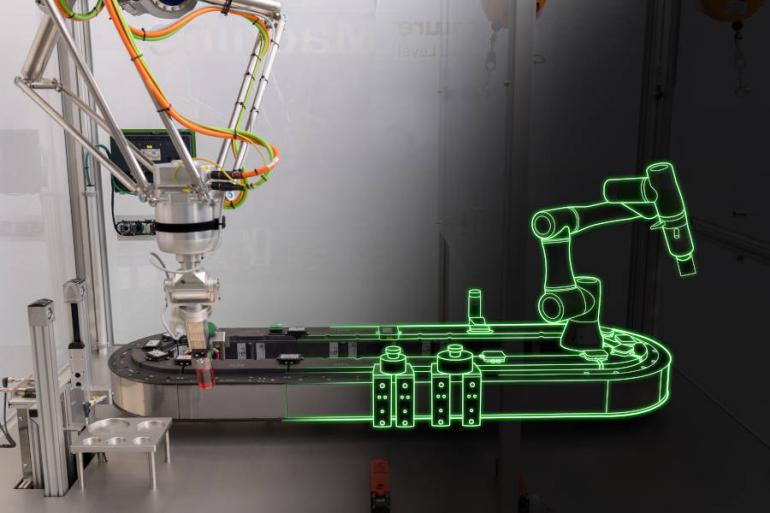
At the core of this transformation lies EcoStruxure™ Machine, an IoT enabled platform encompassing end-to-end solutions – from the smallest component through to software – designed to support the development of a new generation of packaging machinery.
Its value lies primarily in its open and interoperable architecture, based on standard protocols and designed to integrate seamlessly with third-party systems. In this way, automation is no longer a closed system but a connected, scalable ecosystem. This openness is complemented by a unified environment integrating machine control, energy monitoring and analytics, ensuring digital continuity across the entire lifecycle. Virtualisation also plays a decisive role. The digital twin enables machines to be simulated, tested and validated before they are even built, reducing lead times and risk. At the same time, the integration of edge and cloud technologies makes data available and actionable in real time, enabling faster, more informed decision-making.
Another key element is the software defined modularity underpinning specialised architectures such as PacDrive 3, designed with future requirements in mind. The integration of motion control, robotics and automation enables the design of plug-and-play machines capable of rapidly adapting to new production configurations. The benefits are tangible: development times reduced by up to 50%, productivity increased by 24%, and service costs lowered thanks to predictive maintenance.
Future-ready automation, by design
EcoStruxure™ Machine places Schneider Electric’s automation expertise at the heart of machine design: this integrated end-to-end platform, featuring cybersecurity and sustainability by design, reduces energy consumption and complexity without compromising performance. Machine builders are no longer looking simply for technology suppliers, but for partners capable of supporting them throughout their innovation journey.
In this respect, Schneider Electric positions itself as an Energy Technology Partner, combining expertise in automation, energy and digital solutions to support the development of a new generation of industrial machinery. For a sector such as packaging – one that has made adaptability its defining strength – this marks a decisive shift: from designing machines alone to designing the future.