

PPWR: the packaging industry calls on politicians to take action
The Senate discussed the impact of the new European regulation on packaging, with businesses and associations calling for ongoing dialogue to manage the transition phase
Generoso Verrusio
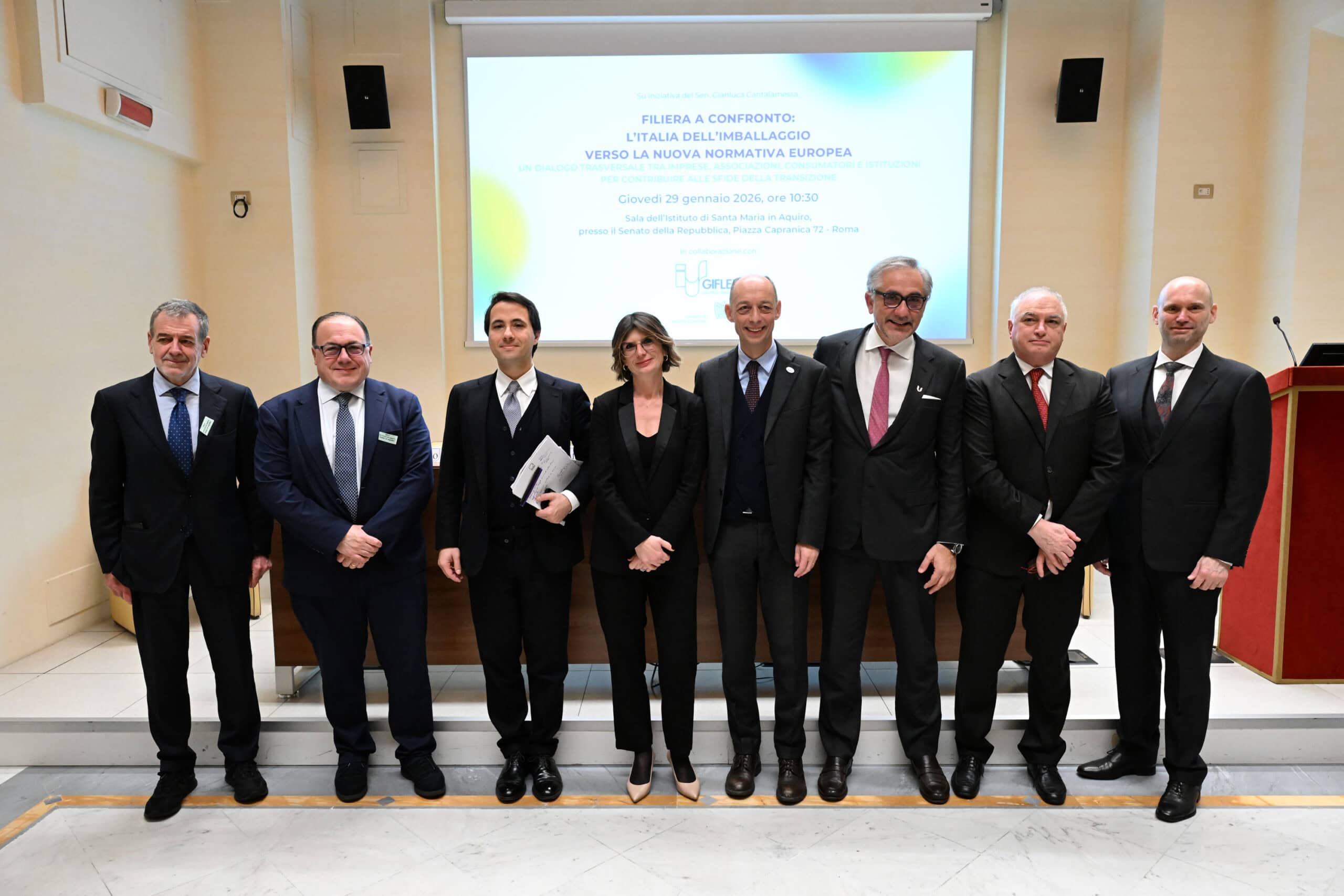
A €51.3 billion supply chain, strategic for Italian manufacturing and at the centre of a decisive regulatory transition, met last Thursday to discuss the impact of the new European Packaging and Packaging Waste Regulation (PPWR).
The meeting, entitled "Supply chain comparison: Italy's packaging industry and the new European legislation", was promoted by Senator Gianluca Cantalamessa and organised by Giflex - Gruppo Imballaggi Flessibili (Flexible Packaging Group).
Domestic packaging production accounts for 3.3% of manufacturing turnover and 1.7% of GDP. In 2024, it reached 17.26 million tonnes, up 1.1% on 2023, with a value of €37.96 billion.
Forecasts indicate a 1% increase in 2025 and an average annual rate of 1.2% until 2028. These are solid figures, but they come at a time of complex transition: the PPWR aims to reduce packaging waste by 15% by 2040, introducing new recyclability standards, reuse targets and reduction targets for products placed on the market.
According to Alberto Palaveri, president of Giflex, "today we need stable and applicable tools for those who produce, use, recover and recycle packaging. Companies cannot work in uncertainty: they need to plan, invest and innovate."
Palaveri emphasised the need for a pragmatic approach, geared towards industrial feasibility, and cited the example of revamping as a model for action to be extended to the new regulatory phase.
Flexible packaging, which weighs on average only 2-3% of the product it contains, is one of the most efficient solutions for reducing the use of raw materials and CO₂ emissions. In 2024, it achieved a turnover of €18.8 billion in Europe, with growth forecasts both globally and in Europe by 2029. In Italy, the sector employs around 12,000 people, produces 400,000 tonnes and generates over €4.3 billion in turnover.
Cantalamessa emphasised the need to defend the competitiveness of Italian-made products: "Europe must recognise and reward those who are ahead of the curve, not penalise them with bureaucracy and rigid rules that apply to everyone. The challenge of reducing waste can be met through a supply chain approach, dialogue with institutions and regulatory flexibility."
Representatives from the sector's leading companies attended the meeting. Alessandra Fazio, president of the Italian Packaging Institute, pointed out that the sector "is one of the pillars of Italian manufacturing" and that today it is called upon to respond to decisive challenges such as ecological transition and material innovation.
Erik Ciravegna, from the University of Bologna, emphasised how packaging has now become "a strategic platform for sustainable innovation in the supply chain, capable of integrating design, data and digital technologies".
Andrea D'Amato, president of the Paper and Graphics Federation, arguing Italy's leadership in the circular economy, warned: "We can overcome European environmental challenges such as the PPWR by combining technological investments with a strategic agenda aimed at safeguarding our competitiveness."
Finally, Vittorio Cino (Centromarca), Riccardo Cavanna (Ucima) and Enrico Barboglio (Acimga) highlighted the need for "clear rules and credible adjustment times, because packaging is not a problem to be reduced, but a function to be enhanced".
In a nutshell, the meeting conveyed the image of a united sector, aware of its industrial strength and the need for stable dialogue with institutions. To tackle a transition that is not only technical but also cultural, the supply chain knows it must proceed with cohesion and a 'spirit of collaboration'.