

Packaging at the heart of global transformations
In early March, Ucima hosted a new edition of the Ethical Packaging Charter Foundation Day, one of the four annual events organised by the Foundation to provide opportunities for in depth analysis and discussion on the issues shaping the packaging supply chain, interpreted through the principles of the Ethical Packaging Charter.
The meeting, titled “Packaging and Global Challenges”, brought together experts from industry, academia and consultancy to examine the major transformations currently affecting the sector: from global economic trends to new European regulations, from technological innovation to the social and cultural implications of the supply chain.
As highlighted throughout the event, packaging is no longer merely a technical element designed to protect and transport products, but a strategic node capable of connecting sustainability, industrial competitiveness, innovation and social responsibility.
Global trends
The day opened with an analysis of international trends in the packaging supply chain by Mecs, Ucima’s research centre, which underlined the economic and industrial weight of the sector worldwide. The industry spans materials, processing machinery and packaging machinery, generating a total value exceeding €200 billion.
Particular attention was given to consumption dynamics in the food & beverage sector, which remains the main market for packaging and shows steady growth prospects in the coming years.
The meeting also recalled the leading role of the Italian packaging machinery industry, comprising more than 600 companies, over 40,000 employees and around €10 billion in turnover, with a strong export orientation and a consolidated presence in major international markets.
Export, regulations and new scenarios
A second focus addressed the challenges linked to international markets, with particular reference to tariff and non tariff barriers that companies must navigate across different regulatory contexts.
Packaging machinery is not simply a set of industrial tools: it is a true vehicle of industrial know how, incorporating technical knowledge relating to products, materials and regulatory requirements in the various destination markets.
In the global context, manufacturers must deal with differing regulatory models: from the self declaration of conformity that characterises the European market to the technical and documentary checks required by several countries for placing machinery on their markets.
Increasingly intelligent packaging
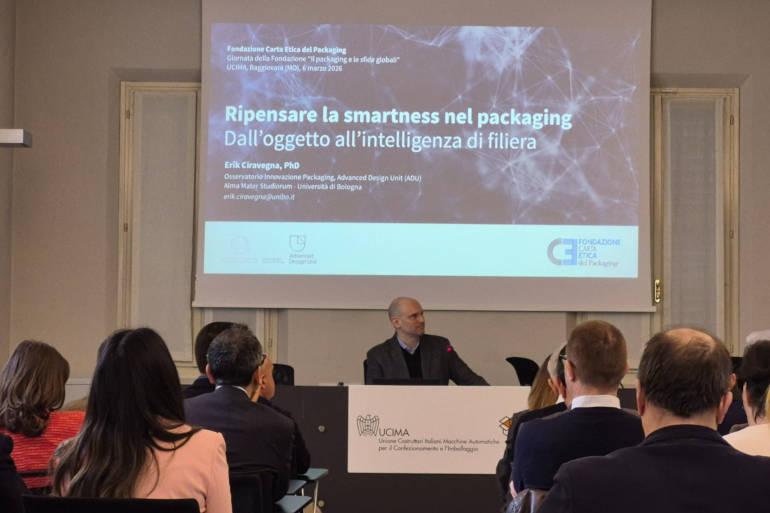
One particularly interesting contribution concerned the evolution of the concept of smart packaging, increasingly oriented towards a systemic logic.
Packaging can no longer be viewed as an isolated object, but as an element that spans the entire product life cycle – from production to logistics, from distribution to end of life – connecting actors, materials, data and responsibilities throughout the supply chain.
In this perspective, intelligence does not lie solely in the technologies integrated into the packaging, but in the supply chain’s ability to share information and coordinate decisions, making the entire production system more efficient and sustainable.
Sustainability and new responsibilities in the value chain
Significant space was devoted to evolving European sustainability regulations, which are redefining corporate responsibilities along the entire value chain.
The new regulatory frameworks require companies not only to declare their commitments, but to demonstrate concrete actions through traceability systems, monitoring tools and independent verification.
Sustainability thus becomes an operational process involving the whole supply chain, from supplier management to data collection, all the way to reporting environmental and social impacts.
Innovation and funding opportunities
The day concluded with an in depth look at funding opportunities for innovation and social impact projects.
Topics included: incentives for industrial and technological investment, tools for skills development in SMEs, programmes dedicated to gender equality, and initiatives supporting corporate social responsibility.
These instruments represent important levers for supporting the development of a sector that must simultaneously address digital transition, environmental sustainability and transformations in global markets.