

At the GIPEA Congress, the future of labels with training and organization taking centre stage
Maria Costanza Candi
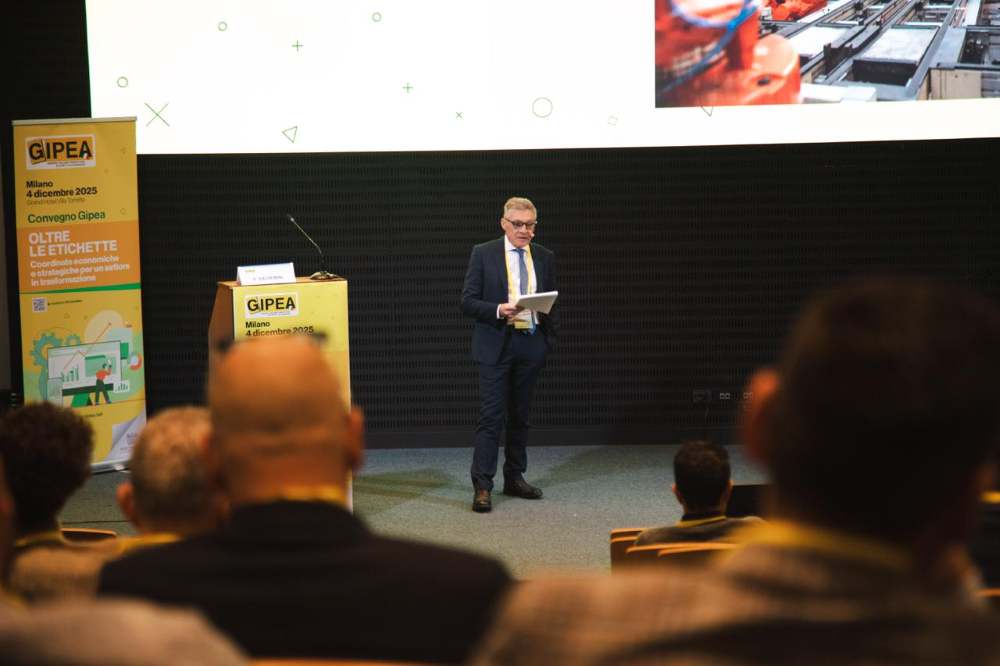
Communicating with consumers, tracking products, ensuring anti-counterfeiting. Labels serve many functions: a legal requirement on one hand, an essential link to the market on the other. These were among the key topics discussed at the GIPEA Congress, entitled “Beyond labels: economic and strategic coordinates for a transforming sector”.
The event combined a snapshot of the sector with the presentation of data from the XIV Economic Observatory, commented on by Gianluca Cinti, Founding Partner of XGen Advisory, and Federico Visconti, Director of Civis Liuc Castellanza. The study paints a picture of a sector where companies, despite modest national GDP growth, have experienced only a limited contraction in revenues due to raw material and energy costs, while maintaining reasonably healthy margins.
Speaking to ItaliaImballaggio about the present and future of the label industry, Gipea President Stefano Salvemini provided an overview of the sector and its competitiveness.
Could you give us a market overview?
“Overall, ours is a consolidated sector”, begins Salvemini. “We have not seen significant increases in volumes or turnover, but rather a consolidation of positions with limited growth. Self-adhesive labels follow the dynamics of large-scale distribution products. In past years, we have benefited from a substitution effect due to changes in labelling, for example moving from water and glue labels to self-adhesive ones. This trend has driven an increase in volumes. The goal is to provide clients with an ever more precise service tailored to their needs, while maintaining margins that, although stable, are narrowing. In addition to rising raw material costs, companies must contend with higher energy costs, increased labour costs due to national contract renewals, and higher COMIECO flat-rate contributions, which reach 2% of turnover for plastic labels. In this context, companies need to focus on cost optimisation and technological innovation. Remaining active in the market with such low margins requires careful attention. Label manufacturers operate with an average profit margin of around 5%, so every process must be carefully controlled”.
Does this reflection fit within the 4.0 and 5.0 frameworks?
“The investment dynamics have followed two main paths. On one hand, there has been the updating of production lines; on the other, an increase in investment in corporate holdings, through acquisitions and mergers. These trends can be seen as a positive signal, as the small size of companies is one of the weaknesses of our sector and, more broadly, of the Italian economy. Small enterprises are less attractive to professionals capable of ensuring a strategic market approach and supporting the entrepreneur with a broader vision and more extensive analytical capacity.
Updating production lines, by contrast, leads to positive outcomes if it is integrated with a rethink of the entire production cycle and a review of all company activities. The goal is to optimise all uneconomical aspects and to reduce inefficiencies”.
Smart labelling and traceability are hot topics, particularly in product categories where anti-counterfeiting is crucial – such as food, wine and spirits, or luxury goods...
“We have the appropriate technologies, but the market is not yet ready to invest in an area that is central not only for the high-end segment but also for food and large-scale distribution. It is worth noting that solutions are available which have a limited impact on label costs, making them a sustainable investment that is immediately repaid through enhanced product image, perceived by consumers as more reliable.
It should also be noted that, aside from technologies like NFC and blockchain, there are lower-cost alternatives, such as the inclusion of micro-texts, variable data elements, and visibility under UV light. These solutions come with different degrees of complexity and cost, offering progressively higher levels of protection. They range from the simplest, suitable for a €1 pack of pasta, to the most sophisticated for high-end products. The challenge, however, lies in the producer’s mindset: they must recognise the importance of anti-counterfeiting and decide to invest in protecting their product. At a recent meeting of the Italian Customs Agency, we were shown counterfeit packs of pasta from some of the cheapest brands on the shelf, costing around 50 cents per pack. The issue of counterfeiting no longer affects only obvious sectors like luxury goods; it now extends to low-cost products, often food items, where lack of traceability can have consequences not only for brand protection but also for consumer health”.
What do you see for the future of the sector? What developments are expected?
“Looking at products, the sector appears relatively mature, yet there is still significant room for development in services. From an Industry 4.0 perspective, the next steps will see internal systems communicating with those of suppliers and customers, making the supply flow as automated as possible. Automation will eventually extend to labels as well, but only if organisation and training are implemented before investing in technology”.