Labels: strength in unity
Gipea, annual conference in Puglia: focus on geopolitics, the PPWR and the sensitive issue of increasing the Conai environmental contribution
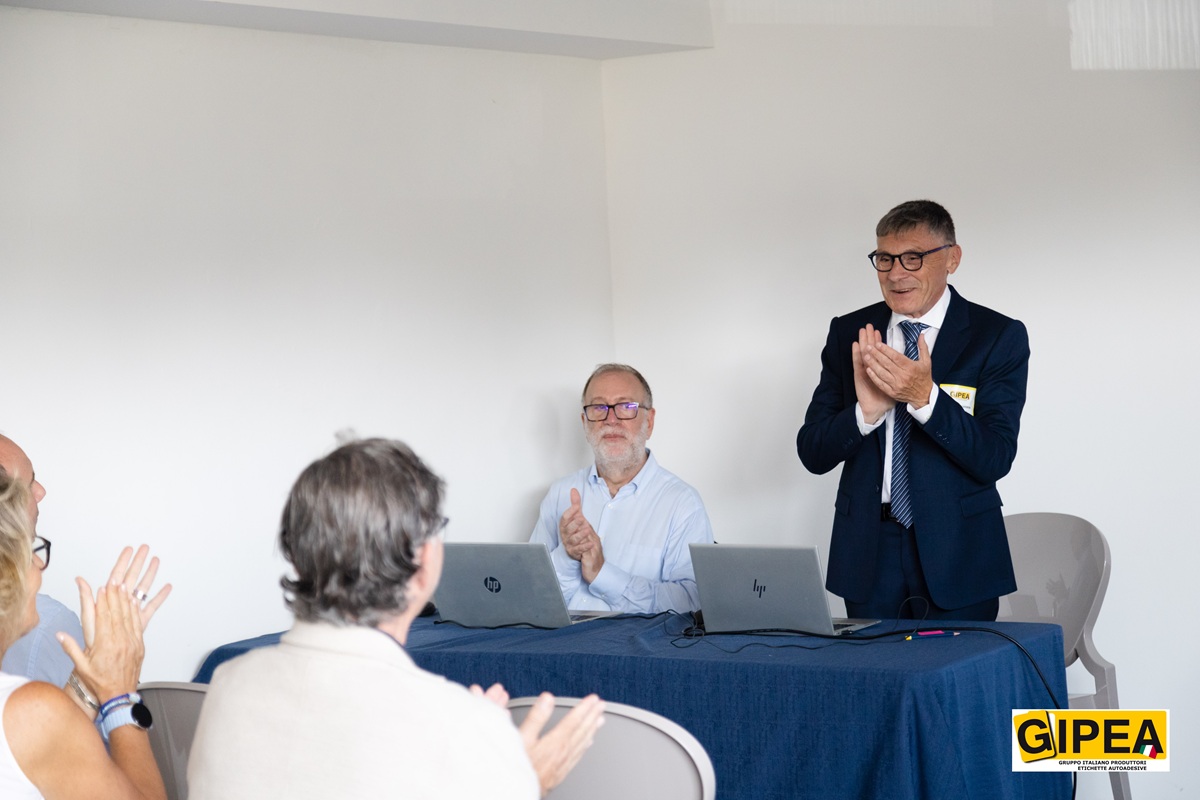
Tariffs and geopolitical tensions, the PPWR, the review of Conai's environmental contribution: there was no shortage of big issues to discuss at Gipea's annual congress. Self-adhesive label manufacturers gathered for two days of networking and professional development in the beautiful setting of the Torre Cintola Hotel in Monopoli. Caressed by the warm wind blowing over the Puglia region, entrepreneurs and technical specialists from across the supply chain delved into the main challenges of the moment and explored the new opportunities offered by technological innovation and artificial intelligence.
Doing the honours were Assografici President Carlo Montedoro (“We are committed to working with Gipea to find the best solutions for the problems of the self-adhesive label industry”, he said) and Gipea President Stefano Salvemini: “Given the scenarios of great uncertainty we find ourselves operating in”, he said, “we need to know how to reinvent ourselves, build coping strategies and cultivate our resilience”.
Among the moments that engaged the audience most was undoubtedly the in-depth discussion devoted to CAC, the Conai environmental contribution. It is widely known that Conai has recently reviewed the calculation methods for the flat-rate procedure for the environmental contribution on labels. In short, Gipea explains, it has provided for a different flat rate on turnover for each material (paper, plastic and aluminium), correlated with the respective CAC in the ordinary procedure, with the result that when fully implemented (2026), the flat rate on turnover related to the placing on the market of self-adhesive plastic labels will increase by almost 20 times compared to 2024. Gipea secretary and Assografici deputy director Italo Vailati provided the audience with a summary of the fundamental role of Conai and the consortium system in Italy. Gipea board member Alberto Ghiotto recalled the reasons for the adoption since the early 2000s of the flat-rate procedure, which allows label manufacturers to pay the CAC obligation ‘at source’, rather than passing it on to users in the invoice, as is the normal practice for all other packaging. Gipea vice-president Gianni Olivieri explained that, given the new calculation procedures, the flat-rate solution is no longer sustainable for label companies (the contribution can amount to 2% of their turnover, when on average companies in the sector have margins of 4%) and that Gipea and Assografici have therefore been in talks with Conai to point out this situation and to ask for a review. These talks have yielded excellent results: the Conai Board of Directors ratified a ‘discount’ on the 2025 flat rate and a working group was re-established to redefine the rules from 2026 onwards. “Gipea and Assografici would like to thank Conai for its sensitivity to a real problem reported by the consortium members and for being open to dialogue”, the group explains. “Now the association's efforts will be focused on the working group, for which Gipea asks for maximum cooperation from member companies”.
Ample time during the Monopoli conference was also devoted to the snapshot of the industry provided by the figures. FINAT board member Vito Giurazza explained the European market trend: “After the market crash of 2023, mainly related to COVID-19 and overstocking, today we are back to a new normal, but with a profoundly different mix. However, in the last three years, Italy has gone from accounting for 11% of the European market up to 13%”. The audience also showed great interest in the analysis, by Francesca Stevens, secretary general of Europen, of legislative developments regarding competitiveness, sustainability and packaging. “We are calling for regulations that are based on scientific data, and that take into account the need to become competitive again in international markets, remembering that there can be no competitiveness without a single European market”.
Lastly, an inevitable reference to the complex geopolitical situation. Carlo Amenta, associate professor of economic, business and statistical sciences at the University of Palermo looked into the direction outlined by the EU to boost business competitiveness, while Giada Messetti, a sinologist who makes television and radio programs, focused on China's role in the international scenario: “China knows that having technological leadership today means having world leadership, and is moving in this direction. Trump's unpredictable policies are helping China to present itself as a consistent and reliable partner”.