


EU Regulation on Bisphenol A: impacts and timelines for food packaging
Bisphenol A (BPA) has for many years been at the centre of European regulatory attention due to its use in food contact materials and articles (FCMs), owing to its toxicological properties and the risks it poses to human health. The new Commission Regulation (EU) 2024/3190, which entered into force on 20 January 2025, marks a significant turning point, introducing a near-total ban on the use of BPA and other bisphenols classified as hazardous, while establishing clearly defined derogations and transitional periods.
The Regulation applies to a wide range of materials, including plastics, coatings, and printing inks, but excludes paper and cardboard unless these are combined with materials subject to the ban.
Recycled FCMs fall outside the scope of the Regulation where the presence of BPA is incidental and unintentional. It is important to note that the external surfaces of packaging may also be subject to the Regulation, where contact with food can reasonably be anticipated. In addition to BPA, the Regulation bans the use of other bisphenols and derivatives classified as CMR substances (carcinogenic, mutagenic, or reprotoxic) or endocrine disruptors (EDs) of category 1A or 1B, such as Bisphenol S (BPS), Bisphenol AF (BPAF), and Tetrabromobisphenol A (TBBPA). However, provision is made for specific authorisations for essential uses, subject to risk assessment by EFSA.
All FCMs within the scope of the Regulation must be accompanied by a specific declaration of compliance (DoC), even where BPA has not been intentionally used, and even during the transitional period. The guidance notes C/2025/6721 relating to Regulation 2024/3190, published on 17 December 2025, clarify that compliance may be demonstrated through technical documentation. As such, Good Manufacturing Practices (GMP) become an essential tool for proving adherence to the ban. In particular, companies must demonstrate to the competent control authorities - through traceability records, supply documentation, operational protocols, process documents, and analytical data - that BPA was neither used nor unintentionally introduced at any stage of the production process.
The aforementioned guidance notes further clarify that where BPA has not been intentionally used in the manufacture of FCMs (food contact materials and articles), compliance may be demonstrated through supporting documentation (e.g. application of GMP, suppliers’ declarations of conformity, lists of monomers/ starting materials). In such cases, analytical testing is optional and at the discretion of the economic operator; where it is relied upon, it must guarantee a detection limit sufficient to exclude the presence of BPA down to 1 µg/kg.
One of the most significant aspects for the packaging sector concerns the timelines of the transitional periods.
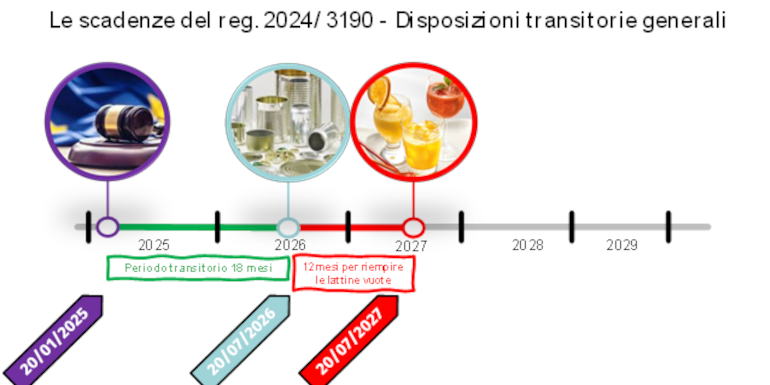
Single-use final articles (e.g., metal packaging)
These may be placed on the market for up to 18 months from the date of entry into force (until 20 July 2026). After this date, unfilled packaging may remain on the market for a further year to be filled with food, whilst packaging already filled may be sold until stocks are exhausted.
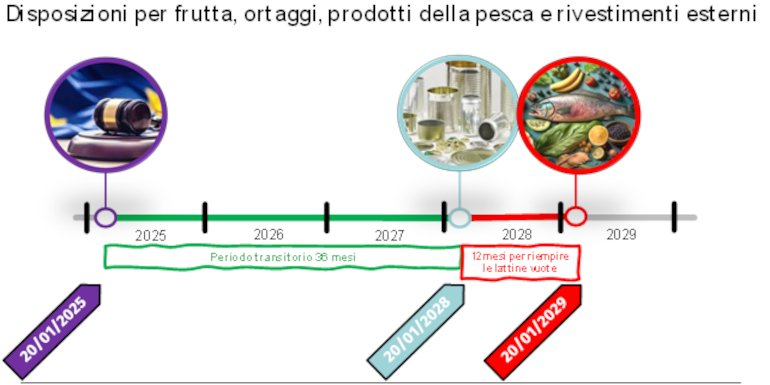
Packaging for fruit, vegetables, and fishery products, and packaging with BPA coating on the external surface only
The transitional period is extended to 36 months (until 20 January 2028), with the same stock exhaustion rules applying.
Reusable articles (e.g. kitchenware, drink bottles)
A transitional period of 18 months, plus one further year for sale to consumers (until 20 July 2027).
Professional food production equipment
A transitional period of 36 months, plus one further year for sale (until 20 January 2029). After this period, articles may only be used by their original owner until such time as the articles cease to be functional, and may not be resold or transferred. Some examples relating to the transitional periods.
Example 1: Single-use metal packaging (beverage cans)
A company manufactures beverage cans with a BPA-based internal coating.
• It may continue to place BPA-containing cans on the EU market until 20 July 2026.
• Cans not yet filled, but placed on the market by this date, may be filled with beverages for a further year (until 20 July 2027).
• Cans already filled and placed on the market within the transitional period may be sold until stocks are exhausted.
• After 20 July 2026, it will no longer be possible to place new BPA-containing cans on the EU market, except under specific derogations.
Example 2: Packaging for fruit, vegetables, and fishery products
A manufacturer of metal cans for preserved fish products uses BPA in its coatings.
• For this category, the transitional period is extended to 36 months (until 20 January 2028).
• Cans not yet filled, but placed on the market by this date, may be filled for a further year (until 20 January 2029).
• Products packaged within the transitional period may be sold until stocks are exhausted.
Example 3: Professional food production equipment
A company supplies confectionery moulds and machinery components containing BPA to food industry manufacturers.
• It may place these articles on the market until 20 January 2028.
• It has until 20 January 2029 to sell them to customers.
• After this date, components already in use may continue to be used by their owner, but may not be resold or transferred.
Example 4: Importing packaging from third countries
A distributor imports plastic packaging from a non-EU country where BPA is still permitted.
• Imported packaging must comply with the same deadlines and requirements as packaging manufactured within the EU.
• After the end of the transitional periods, it will no longer be possible to import and place on the EU market packaging containing BPA.
Conclusions
The new European regulatory framework on BPA requires the packaging sector to undertake a thorough review of both production processes and compliance management. Companies are already carefully planning their transition, taking into account the relevant deadlines and derogations, and will also need to monitor regulatory and scientific developments, particularly with regard to alternatives to BPA and other hazardous bisphenols. The new regulatory framework governing the use of BPA in Europe is clear and binding, and the success of its implementation depends on the robust application of GMPs - which serve not only to demonstrate compliance, but also represent an added value in terms of commercial trust with customers and stakeholders. By 2028, the complete elimination of BPA will become a non-negotiable requirement across the entire food packaging supply chain, including FCMs imported from third countries, which must already comply with the same rules as FCMs manufactured within the EU. This will therefore represent an opportunity to renew technologies and processes in line with the highest safety standards.